


15 Best Hairstyles For Women With Thin Hair
Written by URoots Editorial Team | Medically reviewed by Dr. Ajay, MBBS, QHT Clinic
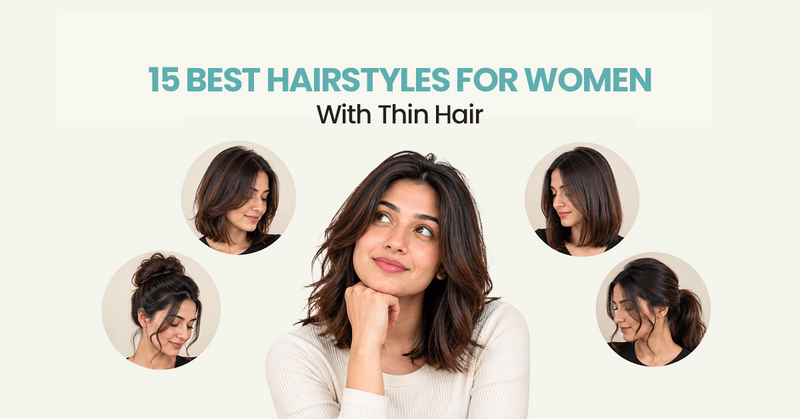
The ponytail tie is wrapping around your hair with one extra coil. Your braid looks thinner, the parting seems wider, and under the bathroom light, more scalp is visible than it was last year. Before you start changing shampoo or seeking a diagnosis, finding a hairstyle that makes your hair look fuller every morning can be the real struggle.
The right cut and parting change how much scalp the light catches. The wrong style adds to breakage or hair fall on top of the thinning already there.
This guide covers hairstyle ideas for thin-haired women, including haircuts that create a fuller-looking outline, partings that make a widening line much less noticeable, gentle ways to add volume, and styles to avoid when your scalp or hairline is already thinning. It draws on guidance from QHT Clinic doctors and published dermatology research.
If you cannot tell whether it is breakage, shedding, or a pattern, a free 2-minute URoots hair test is a sensible place to start.
Why Thin Hair Looks Thinner Than It Is
Hair density naturally changes with age, and the thickness of individual hair fibers can change too. In a study of caucasian women, hair density was highest in the youngest age group and declined with age, while hair fibre diameter continued to increase until around 40-45 years. This helps compensate for the density reduction in early adulthood. After the mid 30s, the combined measure of hair amount begins to decline more noticeably. The study was caucasian, so these age patterns may vary for Indian women.
Once thickening stops, the gap shows, and women notice it from their mid-40s. This does not mean every woman will notice thinning at the same age. Genetics, hormonal changes, medical conditions, scalp conditions, and different types of hair fall can change how and when thinning becomes visible.
For many women, the first visual clue is not a hairline recession or balding crown; it’s the parting that seems wider than before.
Styling cannot create a new follicle. It can only change how much scalp is visible while you work out what is happening underneath.
Hairstyles for Thin Hair: 6 Cuts That Build Volume
Longer hair can be heavier, and weight pulls fine hair flat against the scalp. The best haircuts for fine thin hair keep the ends thick and the shape simple.
1. The blunt bob
Cut at the jaw with one clean line at the ends. Every strand finishes at the same length, which can make ends look denser, particularly when hair has become wispy at the bottom.
2. The lob (long bob)
Collarbone length keeps the full-looking hem and leaves enough to tie back for office or gym.
3. Long hair with face-framing layers only
Keep layers around the face and nowhere else. Pieces starting at the cheekbone add movement where people look first, while the back stays one length.
4. The textured pixie
A short haircut can make fine hair less weighed down. Keeping some length through the top also gives a stylist room to create texture and direction.
5. Curtain bangs or a side-swept fringe
Curtain bangs can soften the appearance of a wider forehead or sparse-looking front hairline. Keep it wispy, so the crown keeps its volume.
6. A soft, chin-length shag
A soft, chin-length shag can add movement to naturally wavy or textured hair. Keep the layers controlled rather than heavily thinning the ends, especially if individual strands are fine. Among volume haircuts, a gentle shag gives wavy hair the most bounce.
If your hair is already fine or sparse, ask your stylist not to reach for thinning shears. Removing too much bulk from the ends can make it look even less substantial.
3 Partings That Hide A Widening Part
A widening mid-part is a common visible feature of female pattern hair loss. In a study of 90 women with FPHL in Western India, 95.6% had widening of the mid-part, at an average age under 35.
That does not mean that every widening part line is a female pattern hair thinning; it can also become more noticeable with shedding, changes in hair density, breakage, or simply wearing the same part for a long time.
7. The deep side part
Shift your part slightly towards one side, towards the arch of one eyebrow, rather than following the same centre line. Hair from the fuller side falls across the thinner centre, and the new line lifts at the root.
8. The zigzag part
Draw a loose irregular zigzag part with a comb tail rather than one perfectly straight line. The uneven distribution of strands breaks up the single visible strip as strands from both sides interlock.
9. The rotating part
If your hair naturally falls flat in the same direction, changing the position of the partline from time to time can alter how the roots sit and distribute hair. Switch sides every few weeks, and they lift in a new direction.
But do not mistake a widening partline for treatment. If your part widens progressively, changing its position will only change the appearance. It does not address the underlying cause.
By the time women bring a widening part to QHT doctors, they have been disguising it for months.
6 Volume Tricks And Gentle Updos
Flat roots by 4 pm. In humid Indian weather, that is the fine-hair routine, and it starts at the dryer.
10. A root-lift blow-dry, done at a distance
Tip your head upside down and dry the roots first. In a lab study, hair tresses were shampooed and dried 30 times over 30 days. The highest temperature condition, 95°C at 5 cm, produced the most severe cuticle damage. A dryer held 15 cm away with continuous motion produced less surface damage than natural air drying.
Use low to medium heat, 15 cm, keep the dryer moving.
11. Soft, heatless waves
Loose bends make each strand take up more space than dead-straight hair. Set them with an overnight loose braid once the hair is mostly dry, no curling iron needed.
12. The half-up twist
Of all the styles to hide thinning crown women ask about, this is the easiest. Take small sections from each side and loosely twist them backwards. Pin them without pulling the hair tightly at the temples or crown.
13. The loose low braid
A relaxed side braid, loosened with your fingers, looks fuller than the hair inside it. Keep it low, away from the front hairline.
14. The claw-clip low bun
A loosely placed claw clip at the nape can be an alternative to a tightly secured high bun. Keep the clip comfortable and avoid styles that create pulling or scalp tenderness.
15. Low-contrast root cover
Scalp becomes more noticeable when there is strong contrast between the hair and the scalp. Camouflage products work by narrowing that colour contrast. Hair fibres work by attaching to existing hair, so they are most useful where some hair remains rather than on a completely bare scalp.
Volume is a trick of light and placement. Neither needs the heat turned all the way up.
The Styles That Quietly Make Hair Fall Worse
If your scalp aches when you take your hair down at night, treat that ache as a warning.
Repeated tension on the hair can cause traction alopecia. Prolonged traction can eventually lead to permanent follicle damage and hair thinning. Tight ponytails, buns, and extensions can contribute to traction alopecia, particularly when they repeatedly pull on the same areas. Risk increases with how hard and how long the hair is pulled, and chemically treated hair is more vulnerable to the damage.
In Indian routines, watch for:
- A tight daily ponytail or choti, carried from school rules into adult life
- Wedding-season updos that rely on tight pins and extensions that tug at their attachment points
- High gym ponytails secured tightly for long periods.
- A tight bun after chemical straightening or relaxing
Chemical damage is quieter. In a study of 19 women who regularly used bleaching, dyeing, and straightening treatments, 42.1% had grade 2 hair shaft changes, including cuticle cracks or holes.
Breakage, traction, and pattern thinning look alike in the mirror, and each needs a different fix. Take the free 2-minute URoots hair test to see which one you are dealing with.
When A Hairstyle Is Not The Real Problem
A fuller-looking hairstyle can hide scalp visibility, but it cannot tell you why your hair is thinning. Look at the pattern as well as the amount of hair you see in the brush. More hairs on your pillow or in the shower drain indicate increased shedding. Short, uneven hair and split ends can point to breakage, while a gradually widening partline or reduced density at the crown can be a sign of genetic hair thinning.
The patterns can overlap, and more than one process can occur at the same time. A hairstyle can camouflage the change, but it cannot diagnose it. If you hair line is progressively widening, shedding is persistent, or you are losing hair in patches, consider seeking professional advice rather than relying on styling alone.
A Simple Daily Routine For Thinning Hair
When hair is fragile or fine, everyday care makes a huge difference; excessive heat, product buildup, and unnecessary friction can contribute to hair shaft damage, hair thinning, or make hair look flatter.
A simple routine starting with gentle cleansing and lightweight scalp or hair care that does not weigh your hair down can help maintain hair and scalp health.
URoots Daily Hydrating Shampoo pairs aloe vera with a conditioning system designed to cleanse while maintaining hydration. This sulfate- and paraben-free formula is designed for everyday cleansing. For a lightweight, leave-on option, URoots Hair Serum with Redensyl® and Procapil® is designed as a lightweight, non-sticky option for daily scalp care.
Our hair care routine for thinning hair guide covers the full sequence for thinning hair.
Final Thoughts
The best hairstyles for thin hair are not necessarily the trendiest ones. They are the ones that make your hair look fuller without repeatedly pulling, overheating, or breaking the strands you still have. A good haircut changes what people see. It does not change what your follicles are doing.
That is the thinking behind URoots’ approach to hair care: make everyday hair care simpler, while helping you understand your hair and scalp before reaching for another quick fix. If your part is getting wider, your shedding has changed, or you cannot tell whether you are dealing with breakage, traction, or pattern thinning, start with the basics and get the problem identified rather than trying to hide it indefinitely.
Your style can hide thinning. It cannot explain it. Take the Free 2-minute URoots Hair Test.
Frequently Asked Questions
What is the best hairstyle for thin hair in women?
A blunt bob or collarbone-length lob can make fine hair look fuller, because a relatively clean, blunt perimeter keeps ends looking more substantial.
Does changing your part make your hair grow back?
No. Changing your part can redistribute the hair visually and make a widening area less noticeable, but it does not increase follicle density or treat the cause of hair loss. If your part continues to widen, consider having the underlying cause assessed.
Is short or long hair better for thin hair?
Shorter hair looks fuller on fine strands because less length and weight are pulling the hair down. If you prefer length, keep layers around the face only and trim the ends regularly.
Can tight ponytails cause hair fall?
Yes. Tight ponytails, buns, or braids worn daily can cause traction alopecia, starting at the temples and hairline. Tenderness after styling is an early sign. Early traction alopecia improves in most cases once the tension stops; years of pulling scar the follicles permanently.
How can I hide a thinning crown?
Pin a half-up twist just below the crown, or move to a deep side part. Keratin fibres or a tinted root powder can reduce the contrast between hair and visible scalp. If the crown keeps thinning, have the cause assessed.
References
- Robbins C, Mirmirani P, Messenger AG, Birch KG, Youngquist RS, Tamura M, et al. What women want: quantifying the perception of hair amount: an analysis of hair diameter and density changes with age in Caucasian women. Br J Dermatol. 2012;167(2):324-32. doi:10.1111/j.1365-2133.2012.10925.x.
- Singh S, Makhecha MB. A cross-sectional, observational study of the clinico-epidemiological profile of female pattern hair loss in Western India and its association with metabolic syndrome. Indian Dermatol Online J. 2023;14(2):181-7. doi:10.4103/idoj.idoj_381_22.
- Lee Y, Kim YD, Hyun HJ, Pi LQ, Jin X, Lee WS. Hair shaft damage from heat and drying time of hair dryer. Ann Dermatol. 2011;23(4):455-62. doi:10.5021/ad.2011.23.4.455.
- Saed S, Ibrahim O, Bergfeld WF. Hair camouflage: a comprehensive review. Int J Womens Dermatol. 2017;3(1 Suppl). doi:10.1016/j.ijwd.2017.01.003.
- Billero V, Miteva M. Traction alopecia: the root of the problem. Clin Cosmet Investig Dermatol. 2018;11:149-59. doi:10.2147/CCID.S137338.
- Kaliyadan F, Gosai BB, Al Melhim WN, Al-Riyami S, Al-Busaidi A, et al. Scanning electron microscopy study of hair shaft damage secondary to cosmetic treatments of the hair. Int J Trichology. 2016;8(2):70-5.
Know Your Hair Fall Before It Worsens
Identify early hairfall signs with personalised expert-backed recovery guidance.
 Take 2 minutes
hair test. (opens in a new tab)