


Itchy Scalp and Hair Fall: Why the Itch Shows Up First
Written by URoots Editorial Team | Medically reviewed by Dr. Ajay, MBBS, QHT Clinic
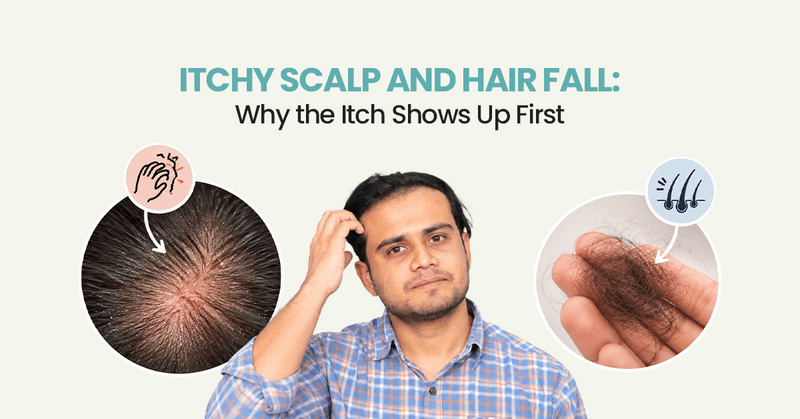
Once the itching starts, it is almost impossible to stop. You catch yourself doing it in a meeting. Nails at the crown, two quick scratches, then again ten minutes later. You scratch to relieve the itch, which seemingly adds to hair fall. shedding is stressful on its own. An itchy scalp on top of it feels like a loop with no way out.
The two are linked, though not the way most people assume. The itch does not pull hair out. The inflammation underneath can contribute to shedding, and repeated scratching can break the remaining shafts.
Healthy hair needs a healthy scalp. When inflammation or a disrupted scalp barrier sits over the follicles, the hair reports it weeks later. An itchy scalp can occur alongside hair fall when conditions such as dandruff, psoriasis, allergic reaction, or fungal infection irritate the scalp.
This guide walks through the reasons a scalp itches, in the order our doctors work through them. Some common causes improve with the right shampoo or scalp-care routine, while others need medical treatment.
If the itching and the shedding started within weeks of each other, the free 2-minute URoots hair test is a calm place to begin.
Key Takeaways
An itchy scalp and hair fall share a single cause rather than one directly causing the other. Dandruff, dryness, product allergy, and infection can irritate or inflame the scalp, while scratching can contribute to breakage. Treating the underlying scalp problem can help reduce related shedding.
- Most common culprit: dandruff, seborrhoeic dermatitis
- Often missed: allergy to a hair dye or new shampoo
- Needs a prescription: fungal infection, scalp psoriasis
- Scratching: breaks shafts, does not uproot healthy hair
- Red flag: itch with smooth, shiny bald skin or pus
Itchy Scalp Hair Fall: What is The Link
Hair moves through growing, resting, and shedding phases on a cycle. On a healthy scalp, about 85% of hairs are in the growing phase at any moment. An itchy scalp does not automatically mean that number has changed.
What the itch does tell you is that the scalp surface is disturbed. Sebum output, free fatty acids and pH hold the scalp in balance, and the lipid composition on the scalp surface shifts in conditions such as atopic dermatitis, seborrhoeic dermatitis and scalp psoriasis.
In dandruff and seborrhoeic dermatitis, researchers have measured three things together on the same scalp: inflammation, faster skin cell turnover and a weakened barrier.
Hair grows out of that skin. Repeated scratching damages the skin, and the follicle sitting in it hands you temporary shedding and breakage.
Treat the scalp, and the hair usually follows it back.
Why is my scalp itchy? Major causes
The easiest way to narrow down an itchy scalp is to look at what comes with the itch: flakes, plaques, broken hairs, a recent product change, or smooth areas of hair loss.
Dandruff and Seborrhoeic Dermatitis
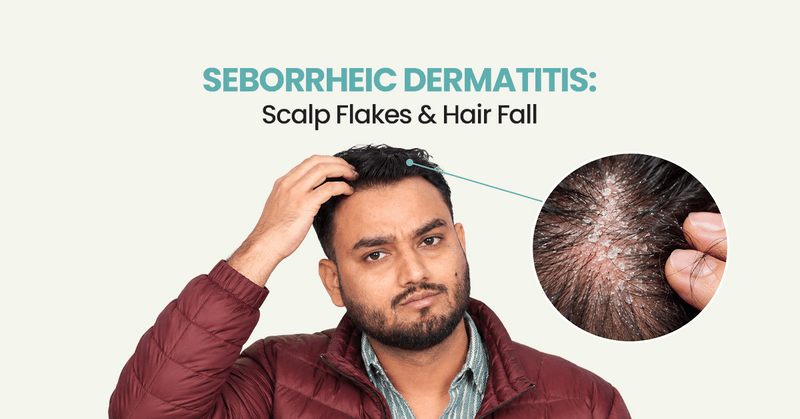
Dandruff is quite common, while its inflammatory form, seborrhoeic dermatitis, affects roughly 16% of the population; half of them report persistent itch. In adults, 70% of the cases involve the scalp. Both are associated with Malassezia, a yeast that every scalp carries. Besides inflammation and scalp itching, hair fall is also commonly associated with both conditions. The severity of the disease eases as flaking comes under control with a medicated shampoo. Our guide to dandruff and hair fall covers this pair in depth.
Scalp Psoriasis
Scalp psoriasis can cause well-defined red or inflamed patches covered with silvery-white scales. Between 67 and 97% of people with scalp psoriasis report itch, and it flares with stress and temperature rather than running at a steady level. Shedding rises while a patch is active. In severe, long-standing disease, psoriatic alopecia can follow. This one does not answer to shampoo alone. It needs a dermatologist and a prescription.
Scarring and Non-Scarring Alopecia
Scarring alopecia such as lichen planopilaris can cause itching, burning, tenderness, redness, and progressive hair thinning. Up to 70% of patients have scalp itch. Because inflammation can permanently damage follicles, smooth or shiny areas of hair thinning, loss of follicular openings, or persistent scalp symptoms should be assessed by a dermatologist.
Non-scarring alopecias, such as alopecia areata and androgenetic alopecia, can also occur alongside an itchy scalp, although the itch may come from a separate scalp condition such as seborrhoeic dermatitis.
Contact Dermatitis
Allergic reactions to hair dye and a new shampoo arrive through a short list of repeat triggers: cocamidopropyl betaine, fragrances, preservatives, henna, and the bovine collagen found in conditioners. Itch shows up in 60% of allergic scalp reactions, and shedding follows the scalp sensitivity. The clue is the calendar. An itch that begins after a salon visit or a product switch can be a clue to contact dermatitis until proven otherwise.
Fungal Infection
Tinea capitis, or ringworm, brings intense itching, redness, and scaling. The fungus penetrates deep into the hair shaft itself, so the hair snaps at the surface and leaves black dots inside bald patches. It looks like severe dandruff with patchy loss, and it is largely a childhood infection. Shampoo will not clear it. Tinea capitis needs oral antifungal medicine, and it can spread through close contact or contaminated items such as shared combs.
Dry, Sensitive Scalps
Hard water, hot showers, and a strong daily shampoo strip oil off faster than your scalp replaces it and worsen dryness and irritation. 60% of people with a sensitive scalp report itch. The giveaway is what you do not see: little visible flaking, and a scalp tight for an hour after a wash.
| What you notice | Where it points | What usually helps |
|---|---|---|
| Flakes, itch worse in winter | Dandruff, seborrhoeic dermatitis | Consider an appropriate anti-dandruff shampoo; seek medical advice if persistent |
| Tight, itchy, few flakes | Dry, over-washed scalp | Gentler shampoo, and avoid very hot water |
| Itch began after a dye or new product | Contact allergy | Stop the trigger and see a dermatologist if symptoms persist |
| Itchy patches, broken hairs, child at home | Fungal infection | Seek medical care promptly; oral antifungal treatment initiated as per doctor’s instructions |
| Thick red plaques, scale at the hairline | Scalp Psoriasis | See a dermatologist for diagnosis and treatment |
| Progressive hair shedding with well-defined bald patches or pattern thinning | Scarring and Non-scarring alopecia | Dermatologist assessment and prescription treatment |
Not sure what your symptoms point to? Take the free 2-minute URoots hair test and find out what your scalp is actually dealing with.
Does scratching Your Scalp Cause Hair Fall?
Not directly. Indirectly, yes.
Scratching does not usually pull hairs directly from an intact follicle, but repeated friction can break hair shafts, irritate the scalp, and worsen inflammation. Dermatologists call that loop the itch-scratch cycle. Left running for months, it produces lichen simplex chronicus, a thickened, leathery patch of scalp with non-scarring hair loss and a telltale finding under magnification: broom fibres, short hairs snapped into pieces by friction.
In non-scarring cases, hair can regrow once the underlying cause and scratching are brought under control. The catch is that scratching becomes a habit your hands run without you, in traffic, at a desk, half asleep.
Scratching scalp hair fall is a breakage problem sitting on top of an inflammation problem. Both are fixable.
How To Calm an Itchy Scalp Without Losing More Hair
If the itch is coming from dandruff or seborrhoeic dermatitis, treatment often starts with the right scalp-cleansing routine.
- Match the shampoo to the cause: For itch with visible flaking caused by dandruff or seborrhoeic dermatitis, a ketoconazole-containing medicated shampoo may be recommended.
URoots Knix KZ medicated shampoo contains 2% ketoconazole and 1% zinc pyrithione, and should be used 2 to 3 times a week as directed by your doctor.
- Leave it on long enough: Give medicated shampoo enough time to work. 3 to 5 minutes on the scalp, or as mentioned on the label, before rinsing.
- Soften the other washes: On non-medicated days, a mild sulphate-free wash such as the URoots hydrating shampoo keeps a dry, reactive scalp comfortable.
- Be selective with oil: Avoid oils or multiple new products while the scalp is actively inflamed or irritated. If dryness is the main issue, a light cosmetic oil like Pure Scalp Nourishing Oil suits a dry scalp. Skip it while a scalp is flaring or infected.
- Cut the nails, cool the water, drop the suspect: Use lukewarm water rather than very hot water, which may be less irritating for a sensitive scalp. If a dye or salon treatment landed in the fortnight before the itch, stop it and note the date for your doctor.
None of these treat pattern thinning or replace a prescription for an infected scalp. They keep the surface calm enough for hair to hold on.
Give it a routine for 4 weeks. Judge the itch first, the shedding second.
When scalp itching and hair loss need a doctor
Some itching is a dermatology appointment, not a shampoo decision. Book one for any of these.
- Smooth, shiny bald skin where follicles used to be. Itch runs through the scarring conditions, with pruritus in 54% to 90% of lichen planopilaris patients and 65% of discoid lupus cases.
- A painful, boggy, or pus-filled swelling, particularly with fever or rapidly worsening symptoms.
- Patchy loss with broken hairs in a child
- Persistent itching despite appropriate treatment.
- Hair shedding that continues or worsens after the scalp symptoms have settled, which may point to a separate hair fall condition.
The itch is the symptom you notice. The pattern around it is what gives a doctor the diagnosis.
Final thoughts
An itchy scalp is a symptom, not a diagnosis. Sometimes the same condition causes both itching and shedding; sometimes the two problems simply happen together. Identify the cause first. Dandruff may respond to medicated shampoo, irritation may improve after removing the trigger, while psoriasis, infection, and scarring conditions need targeted medical treatment.
Start with the wash. A medicated shampoo for genuine dandruff, a gentler one for a dry scalp, and a month of honest use before you add anything else.
What we would not do is treat itchy scalp and hair fall as a hair problem alone. Serums and supplements have their place further down the line, on skin that is no longer inflamed and scratched twice an hour.
Calm the scalp first. Everything else works better on quiet skin.
Itching for weeks, and shedding with it? Find out why.
Two minutes of questions help our doctors point you at the right starting place for your scalp.
Take the Free URoots Hair Test
Frequently asked questions
Can an itchy scalp cause hair fall?
Indirectly, yes. Conditions that cause scalp itching can also cause inflammation, while repeated scratching can contribute to hair breakage. Treating the underlying scalp condition can help reduce related shedding.
Why is my scalp itchy but no dandruff is visible?
Dryness is the usual answer, especially with hard water and hot showers. Contact allergy to a dye or hair product comes next, and it burns more than it flakes. Scalp psoriasis and early eczema also itch before much shows.
Will hair grow back after an itchy scalp is treated?
In non-scarring cases, yes. Shedding driven by scalp inflammation or scratching reverses once the cause is corrected, though regrowth takes up to 6 months. Hair does not return where skin has scarred, which is why a stubborn itch deserves an early opinion.
Why is my scalp itchy and I'm losing hair?
An itchy scalp and hair loss can occur together when conditions such as dandruff, seborrhoeic dermatitis, psoriasis, contact dermatitis, or fungal infection irritate the scalp. Repeated scratching can also contribute to hair breakage. If the itching persists, becomes painful, or occurs with patchy or shiny areas of hair loss, see a dermatologist to identify the underlying cause.
What vitamin deficiency causes itchy scalp and hair loss?
There is no single vitamin deficiency that explains every case of itchy scalp and hair loss. Nutritional deficiencies, including iron, vitamin D, zinc, or certain B-vitamin deficiencies, can contribute to hair shedding, but scalp itching usually has another underlying cause. If hair loss is persistent or accompanied by other symptoms, a doctor can decide whether blood tests for nutritional deficiencies are appropriate.
References
- Vázquez-Herrera NE, Sharma D, Aleid NM, Tosti A. Scalp itch: a systematic review. Skin Appendage Disord. 2018;4(3):187-199. doi:10.1159/000484354.
- Piérard-Franchimont C, Goffin V, Henry F, Uhoda I, Braham C, Piérard GE. Nudging hair shedding by antidandruff shampoos: a comparison of 1% ketoconazole, 1% piroctone olamine and 1% zinc pyrithione formulations. Int J Cosmet Sci. 2002;24(5):249-256. doi:10.1046/j.1467-2494.2002.00145.x.
- Tucker D, Syed HA, Masood S. Seborrheic dermatitis. In: StatPearls [Internet]. Treasure Island (FL): StatPearls Publishing; 2024.
- Al Aboud AM, Crane JS. Tinea capitis. In: StatPearls [Internet]. Treasure Island (FL): StatPearls Publishing; 2023.
- Hughes EC, Syed HA, Saleh D. Telogen effluvium. In: StatPearls [Internet]. Treasure Island (FL): StatPearls Publishing; 2024.
- Schwartz JR, Messenger AG, Tosti A, Todd G, Hordinsky M, Hay RJ, et al. A comprehensive pathophysiology of dandruff and seborrheic dermatitis: towards a more precise definition of scalp health. Acta Derm Venereol. 2013;93(2):131-137. doi:10.2340/00015555-1382.
- Malhi K, Singh S, Mehta H, De D, Dogra S, Bishnoi A. Lichen simplex chronicus of the scalp: a clinical and trichoscopic perspective. Indian J Dermatol Venereol Leprol. 2024;90(6):819-822. doi:10.25259/IJDVL_1274_2023.
- Bin Saif GA, Ericson ME, Yosipovitch G. The itchy scalp--scratching for an explanation. Exp Dermatol. 2011 Dec;20(12):959-968. doi:10.1111/j.1600-0625.2011.01389.x. PMID:22092575; PMCID: PMC3233984.
Know Your Hair Fall Before It Worsens
Identify early hairfall signs with personalised expert-backed recovery guidance.
 Take 2 minutes
hair test. (opens in a new tab)