


Seborrheic Dermatitis: Scalp Flakes & Hair Fall
Written by URoots Editorial Team | Medically reviewed by Dr. Ajay, MBBS, QHT Clinic
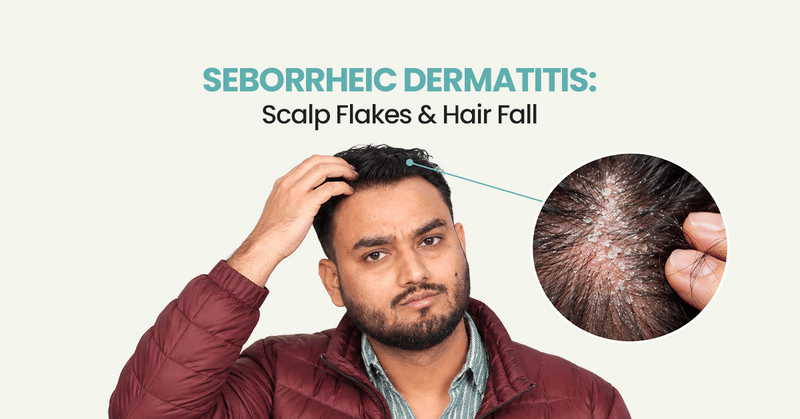
You washed your hair this morning. By evening, there is a fine dusting across the shoulders of a dark shirt. The skin behind your ears feels tight, and the flakes are not the dry white kind. They are yellowish, slightly greasy, and stuck to a red, itchy scalp.
That pattern points to seborrheic dermatitis, a chronic inflammatory skin condition that affects oily areas such as the scalp, eyebrows, sides of the nose, and behind the ears. Its signs can look different across skin tones. It sits on the same spectrum as dandruff, but inflammation makes seborrheic dermatitis more than simple flaking, which is why medicated shampoo helps, and a regular one does not.
It does not destroy follicles. Instead, inflammation and scratching can increase shedding and make an already irritated scalp uncomfortable. This guide explains how to tell it apart from ordinary dandruff, what the hair fall means, and how our doctors settle a flare.
If the flaking and the shedding arrived together, the free 2-minute URoots hair test is a sensible first step.
Key takeaways
Seborrheic dermatitis and dandruff are closely related conditions, with seborrheic dermatitis involving more obvious inflammation. Yellow greasy flakes, redness and itching on the scalp, often spreading to the eyebrows and the creases of the nose. It is usually a condition you manage rather than permanently cure; associated shedding can improve when the scalp inflammation settles.
- The tell: greasy yellow flakes on red skin, not dry white flakes on normal skin
- The cause: an interaction between scalp yeast, Malassezia, scalp oils, the skin barrier and the immune response.
- The hair fall: non-scarring, and it settles when the scalp settles
- The backbone of treatment: an antifungal medicated shampoo, used correctly
- The pattern: flares can be more common in winter, may ease in summer, and may recur if you stop maintenance
- Red flag: patchy loss with broken hairs, or smooth shiny skin where hair used to be
What Seborrheic Dermatitis of the Scalp Actually Is
Seborrheic dermatitis affects 4.48% of the population globally, primarily affecting adults. Its exact pathogenesis is not fully understood, but several possible factors appear to contribute, including alteration of the scalp microbiome, dysfunction of sebaceous gland activity, and the individual’s immune response.
Malassezia sp., a fungus, lives on every human scalp and is involved in seborrheic dermatitis. It cannot make its own fats, so it feeds on yours: its enzymes break down the triglycerides in sebum and release free fatty acids such as oleic acid. On most scalps, nothing happens. Higher sebum production and dysregulation of the skin’s immune response may predispose some people to the condition. When the skin barrier is impaired, those fatty acids trigger an altered immune response and inflammation. The result is visible: flaking, redness, itch.
Researchers have provided useful evidence for the role of the skin barrier. Oleic acid painted on the scalp of people without dandruff did nothing. Painted on the unaffected scalp of people with dandruff, it produced flaking. The findings suggest that the interaction between Malassezia-derived lipids and an individual’s skin barrier and immune response helps determine who develops visible inflammation.
To a dermatologist, it looks like salmon-coloured patches carrying a fine white scale and a yellowish greasy crust.
It is a skin problem with a hair consequence, not a hair problem.
What Does Seborrheic Dermatitis Look Like on Your Scalp
Seborrheic dermatitis is reported more frequently in men than in women. The presence of visible redness, greasy scale, and itch helps distinguish it from simple dandruff.
Clinically, it presents as red to orange patches with thick, yellowish greasy scales. Scalp itch is also common. Facial lesions are symmetrical and can spread across the middle third of the face, including cheeks, central forehead, beside nose, and sometimes upper chest. In darker skin, redness may be less apparent, while hypopigmentation and subtle scaling may be more noticeable.
Seborrheic Dermatitis vs Dandruff: Yellow Scalp Flakes and the Line Between Them
Dandruff and seborrheic dermatitis are closely related and are often considered to lie on the same clinical spectrum, separated by severity and by how far it spreads. Dandruff typically causes flaking and itching without obvious inflammation, and is generally confined to the scalp. Seborrheic dermatitis brings marked redness, and it travels to the facial regions as well.
| Factor | Dandruff | Seborrheic dermatitis |
|---|---|---|
| Skin underneath | Normal colour | Red, sometimes shiny |
| Flakes | White to yellowish, loose scale | Yellow, greasy, adherent scale |
| Where | Scalp only | Scalp plus brows, nose folds, behind ears, chest |
| Itch | Mild to moderate | Moderate, with soreness or burning |
| Typical treatment | Cosmetic anti-dandruff shampoo | Antifungal or anti-inflammatory, medicated |
If your flakes are white and your scalp underneath is a normal colour, read our guide to dandruff and hair fall instead. Red skin under yellow scalp flakes moves you into a different treatment plan.
Does Seborrheic Dermatitis Cause Hair Fall?
Here the internet oversells and under-explains, so take it in three parts.
What the Studies Show
Medicated antidandruff shampoos help reduce shedding and are associated with hair growth cycle changes in people with dandruff and seborrheic dermatitis. In a study of 150 men followed for 6 months, a medicated shampoo cut hair shedding by 17.3% with 1% ketoconazole, 16.5% with piroctone olamine, and 10.1% with zinc pyrithione, and the proportion of actively growing hairs rose in every group.
What the Evidence Does not Show
Seborrheic dermatitis is not a cause of true hair loss in the way male or female pattern baldness is. It does not miniaturise follicles the way DHT does, and it does not scar them shut. Patterned or persistent hair thinning should prompt evaluation for another diagnosis.
The Verdict
Severe dandruff hair loss is real but borrowed. Inflammation and scratching may contribute to increased shedding, while persistent shedding can also have other causes. This type of shedding can improve once the underlying trigger is controlled. The regrowth and hair density take several months to visibly catch up after the scalp has settled.
Flaking for months and now shedding with it? Take the free 2-minute URoots hair test and get a clear read on what your scalp is dealing with.
Scalp seborrheic dermatitis treatment that works
Medicated shampoo does most of the work.
Ketoconazole is one of the best-studied antifungal treatments for seborrheic dermatitis. In a study of patients with moderate to severe scalp seborrhoeic dermatitis, 2% ketoconazole shampoo used twice weekly for 2 to 4 weeks produced an excellent response in 88%. Head-to-head against 1% zinc pyrithione, ketoconazole 2% brought severity scores down 73% at week 4 against 67%, with fewer recurrences afterwards.
URoots Knix KZ contains 2% ketoconazole with zinc pyrithione. It is to be used 2 to 3 times a week as directed by your doctor. Our ketoconazole shampoo guide explains the active ingredient in detail. Results vary between scalps, and a medicated shampoo is a treatment decision, not a shopping decision.
How you Wash Decides Whether it Works
How you use the shampoo matters almost as much as which active ingredient you choose.
- Give it contact time. 3 to 5 minutes on the scalp, not 30 seconds on the lengths. An antifungal shampoo needs adequate time to work as intended, so rinsing it off immediately reduces its effectiveness.
- Part and apply. Flakes sit on skin, so the product has to reach skin. Fingertips, not nails.
- Lukewarm water, always. Use lukewarm rather than very hot water. Hot water strips an already sensitive barrier.
- Soften the in-between washes. On non-medicated days, a mild sulphate-free shampoo such as the URoots hydrating shampoo can be used to keep a sore scalp comfortable.
- Pause the oiling during a flare. A light cosmetic oil like Pure Scalp Nourishing Oil may be used on a dry, calm scalp between episodes. During an active flare, consider pausing heavy or prolonged scalp oiling.
What a prescription adds
When shampoo alone is not enough, dermatologists may prescribe a short course of topical corticosteroids, ciclopirox, calcineurin inhibitors, or oral antifungal tablets depending on the severity and extent of disease. These are prescription decisions with real side-effect profiles. These treatments should be used only with medical guidance, with the dose and duration appropriate to the individual case.
Four weeks of the right shampoo, used properly, tells you more than four months of switching bottles.
Why it Keeps Coming Back
Because seborrheic dermatitis is a chronic condition, treatment is about controlling flares and preventing recurrence rather than permanently eliminating the condition.
The rhythm is seasonal. Seborrheic dermatitis flares in winter and eases in summer. Flares are also linked to stress and sleep deprivation and may coincide with worsening symptoms in some people. Maintenance is the part people skip, and it is the part with the best data. Studies suggest that once-weekly ketoconazole shampoo can help maintain control and reduce relapse by more than half after an initial treatment course.
Patients who return to our doctors with a second flare have almost always done the same thing. Felt better in week 3, stopped in week 4.
Other risk factors associated with seborrheic dermatitis include:
- Male sex, as seborrheic dermatitis is reported more frequently in men.
- Neurological conditions: Including Parkinson’s disease, alzheimer dementia, and major depression
- Certain Metabolic conditions
- Individual and genetic susceptibility
- Immunosuppression, including HIV and hepatitis C
When it Needs a Doctor
Flaking is rarely urgent. These signs are.
- Patchy hair fall with short broken hairs or black dots, especially in a child. That pattern suggests tinea capitis, a fungal infection of the scalp and hair shaft, not seborrheic dermatitis, and it often requires oral antifungal treatment.
- Smooth, shiny skin where follicles have disappeared. Scarring conditions present differently and need prompt assessment because follicular damage can be permanent.
- Pus, crusting, or a boggy tender swelling.
- No improvement after 4 to 6 weeks of correct medicated shampoo use.
- Unusual severity or a rash spreading well beyond the scalp, which occasionally flags an underlying medical condition.
You are not looking for flakes at this appointment. You are looking for the pattern around them.
Final thoughts
Seborrheic dermatitis of the scalp is one of the more manageable cases of scalp flaking, and one of the most persistently mismanaged. People treat it as a cosmetic nuisance for years, switching bottles every fortnight, and never give one appropriate treatment enough time to assess whether it is working.
Do the opposite. Confirm what you actually have, since dandruff and seborrheic dermatitis need different products. Use one medicated shampoo properly, with contact time, for a month. Keep a maintenance wash going through winter even after the flakes stop. See a dermatologist if the symptoms are not improving after several weeks of appropriate treatment, or sooner if the scalp is painful, oozing, significantly inflamed, or associated with patchy hair loss.
The shedding often causes the most anxiety, but when it is related to scalp inflammation or scratching, it can improve as the scalp settles. Persistent shedding still deserves a separate evaluation.
Settle the scalp first. Then give the hair time to catch up.
Flaking through every winter, and shedding with it?
Two minutes of questions help our doctors point you at the right starting place for your scalp.
Take the Free URoots Hair Test
Frequently asked questions
Is seborrheic dermatitis the same as dandruff?
They are closely related conditions that are often considered part of the same clinical spectrum. Dandruff means flaking and itch with no visible inflammation, confined to the scalp. Seborrheic dermatitis adds redness and spreads to the eyebrows, nose folds, and behind the ears. The red skin underneath is what separates them.
Will my hair grow back after seborrheic dermatitis?
Usually, if the shedding is related to seborrheic dermatitis, hair density can improve once the scalp inflammation settles. This condition does not scar follicles, and shedding triggered by scalp inflammation reverses once the inflammation settles. Expect visible density to return over 3 to 6 months rather than weeks, as follicles cycle back into their growing phase.
How often should I use ketoconazole shampoo for seborrheic dermatitis?
Clinical trials have used 2% ketoconazole shampoo twice weekly during the initial treatment period, with less frequent use for maintenance. Follow the frequency on your label or your doctor's instruction, and do not use a prescription-strength shampoo daily on the assumption that more is faster.
Does oiling make seborrheic dermatitis worse?
Heavy or prolonged scalp oiling may aggravate symptoms in some people, particularly during an active flare. If you notice more scaling or irritation after oiling, pause it until the flare settles.
Is seborrheic dermatitis contagious?
No. It involves your skin barrier, scalp oils, and Malassezia, a yeast that normally lives on the skin. It will not spread from a pillow or a comb, and you cannot pass it on.
References
- Tucker D, Syed HA, Masood S. Seborrheic dermatitis. In: StatPearls [Internet]. Treasure Island (FL): StatPearls Publishing; 2024. https://www.ncbi.nlm.nih.gov/books/NBK551707/
- Borda LJ, Wikramanayake TC. Seborrheic dermatitis and dandruff: a comprehensive review. J Clin Investig Dermatol. 2015;3(2):10. doi:10.13188/2373-1044.1000019. https://www.avensonline.org/wp-content/uploads/JCID-2373-1044-03-0019.pdf
- Peter RU, Richarz-Barthauer U. Successful treatment and prophylaxis of scalp seborrhoeic dermatitis and dandruff with 2% ketoconazole shampoo: results of a multicentre, double-blind, placebo-controlled trial. Br J Dermatol. 1995;132(3):441–445. https://academic.oup.com/bjd/article-abstract/132/3/441/6680955
- Piérard-Franchimont C, Goffin V, Decroix J, Piérard GE. A multicenter randomized trial of ketoconazole 2% and zinc pyrithione 1% shampoos in severe dandruff and seborrheic dermatitis. Skin Pharmacol Appl Skin Physiol. 2002;15(6):434–441. https://pubmed.ncbi.nlm.nih.gov/12476017/
- Piérard-Franchimont C, Goffin V, Henry F, Uhoda I, Braham C, Piérard GE. Nudging hair shedding by antidandruff shampoos: a comparison of 1% ketoconazole, 1% piroctone olamine and 1% zinc pyrithione formulations. Int J Cosmet Sci. 2002;24(5):249–256. https://pubmed.ncbi.nlm.nih.gov/18498517/
- Hughes EC, Syed HA, Saleh D. Telogen effluvium. In: StatPearls [Internet]. Treasure Island (FL): StatPearls Publishing; 2024. https://www.ncbi.nlm.nih.gov/books/NBK430848/
- Navarro Triviño FJ, Velasco Amador JP, Rivera Ruiz I. Seborrheic dermatitis revisited: pathophysiology, diagnosis, and emerging therapies: a narrative review. Biomedicines. 2025;13(10):2458. doi:10.3390/biomedicines13102458.
- Jackson JM, Alexis A, Zirwas M, Taylor S. Unmet needs for patients with seborrheic dermatitis. J Am Acad Dermatol. 2023;88(3):e77-e78. doi:10.1016/j.jaad.2022.12.017.
- Turchin I, Albrecht L, Hanna S, et al. Current understanding of seborrheic dermatitis: epidemiology, burden of disease, and pathophysiology. J Cutan Med Surg. 2025;29(4 Suppl):5S-15S. doi:10.1177/12034754251368840.
- Dall'Oglio F, Nasca MR, Gerbino C, Micali G. An Overview of the Diagnosis and Management of Seborrheic Dermatitis. Clin Cosmet Investig Dermatol. 2022 Aug 6;15:1537-1548. doi: 10.2147/CCID.S284671. PMID: 35967915; PMCID: PMC9365318.
Know Your Hair Fall Before It Worsens
Identify early hairfall signs with personalised expert-backed recovery guidance.
 Take 2 minutes
hair test. (opens in a new tab)