


Scalp Exfoliation: How to Clear Buildup Safely
Written by URoots Editorial Team | Medically reviewed by Dr. Ajay, MBBS, QHT Clinic
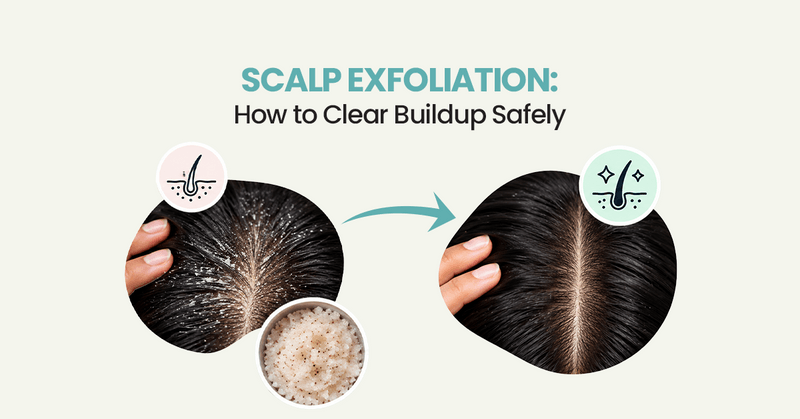
Count the bottles in your shower. Shampoo, conditioner, maybe a serum, a styling cream, a weekly hair oil. Everything you put on your hair has to come back off, and the bit that never fully rinses away settles on your scalp along with your own oil, sweat, and dead skin.
That is scalp buildup: a mix of oil, sweat, dead skin, and leftover hair products that ordinary shampoo does not fully clear. Scalp exfoliation is how you remove it. Done gently, it lifts that layer off the skin at the roots, so your scalp feels clean instead of coated.
Here is the answer. A clear scalp is a healthier home for your hair, and letting buildup sit can leave the scalp itchy and irritated. Exfoliation is not a hair fall treatment, though. It will not reverse thinning or pattern hair loss on its own.
This guide, backed by QHT Clinic doctors, walks you through the signs of buildup, physical versus chemical methods, how often to do it, and when a scalp needs a doctor instead of a scrub.
What Scalp Exfoliation Does and What It Can't
Your scalp behaves a lot like the skin on your face. It makes oil to keep hair and skin healthy, and when that oil builds up past what a wash removes, a scrub or exfoliating step goes where shampoo stops. That is the whole job of scalp exfoliation: clearing the oil, sweat, dead skin, and product residue that collect right at the roots.
What it does well is real. It takes off the layer shampoo leaves behind, and it eases the irritation and flaking that excess oil can bring on. A cleaner scalp is a more comfortable one, and less prone to flaking. One thing our doctors flag in follow-ups: patients expect a scrub to bring hair back, and it does not do that.
So here is the line to hold on to. Clearing buildup supports the scalp. It is not a fix for hair fall or thinning you can see in the mirror, and it will not regrow hair that is already gone. If your hair is genuinely thinning, that has its own causes and deserves a proper look, not a rougher scrub.
Signs of Product Buildup On Scalp
You can spot buildup by what it leaves behind: pale flakes sitting close to the roots, an itch, and skin that turns oily or crusty. Some people get scaly patches or a little redness too. The tricky bit is that these same signs show up in other scalp conditions, which is why buildup gets misread so often.
What piles up falls into two groups. First, what you put on: shampoos, conditioners, styling gels and creams, ointments, and hair oils. Second, what your body makes: sweat, oil, and dead skin. Two everyday Indian habits push this along.
Heavy hair oiling that never gets fully rinsed out leaves oil sitting on the scalp. And dry shampoo between gym days or long commutes stacks up product without a real wash.
Scalp buildup vs dandruff: how to tell the difference
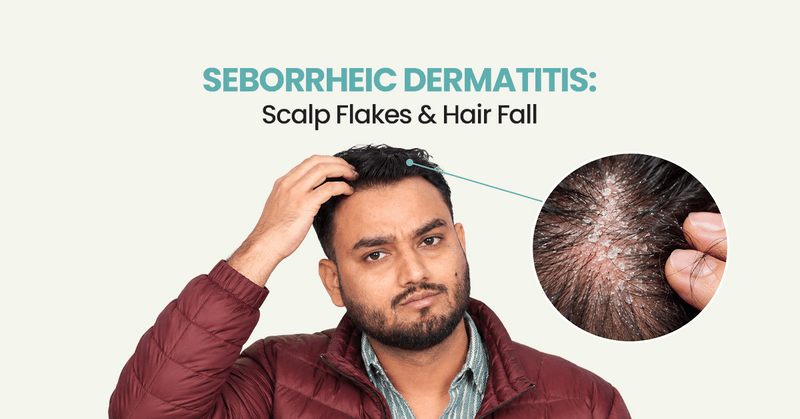
This is where a lot of people go wrong. Buildup and dandruff can look almost identical, both flaky, both itchy, yet they are not the same problem. Buildup is residue: oil, sweat, dead skin, and product a wash left behind. Dandruff is a skin condition. It is a mild form of seborrheic dermatitis, driven by a yeast called Malassezia that lives on nearly everyone's scalp and feeds on its natural oil. When that yeast overgrows, the skin reacts with flaking and itch.
Why it matters: a scrub clears residue, but it does nothing about the yeast behind true dandruff. If your flakes keep coming back after a proper clean, you are probably dealing with dandruff, not just buildup, and the fix is different. Work out which one you have before you reach for anything.
Physical Vs Chemical Exfoliation: Which is Right For Your Scalp
Two paths lead to the same clean scalp, and the right one depends on your skin, not on which sounds fancier. One works by touch. The other works in chemistry.
| Factor | Physical exfoliation | Chemical exfoliation |
|---|---|---|
| How it works | Grit rubs buildup and dead skin off the surface | Acids dissolve the bonds holding dead skin cells |
| Common types | Salt, sugar, charcoal, clay scrubs; scalp brushes | Salicylic acid (a BHA); glycolic and lactic acid (AHAs) |
| Suits | Scalps that handle a gentle rub | Anyone who would rather not scrub |
| Watch out for | Coarse grains can nick skin if you scrub hard | Follow the label; more is not better |
Scalp exfoliating scrub and other physical methods
This is the hands-on route. A scalp exfoliating scrub uses small gritty particles, sugar, salt, charcoal, or clay, that you massage over the skin to lift buildup.
Grain size decides how rough it is. Big, coarse grains scrub harder and can nick the skin if you go at it vigorously, while finely ground sugar or clay stays gentler.
A scalp brush does a related job: used on a dry scalp before you shower, it loosens product and dead skin so the rest of your routine works better. A scalp scrub is best for scalps that get oily or collect a lot of product.
Chemical exfoliation, and when flaking is really dandruff
Some scalps do better without any rubbing at all. That is where chemical exfoliation comes in. Instead of grit, it uses acids that dissolve the bonds holding dead skin cells together, so they rinse away. The ones you will meet most are salicylic acid, a BHA, and the AHAs glycolic and lactic acid. No rubbing means no coarse grains to nick the skin.
There is a catch worth naming. If your flaking is dandruff rather than plain buildup, an acid or a scrub is not the target. Dandruff is managed with anti-dandruff shampoos built around zinc, selenium, coal tar, or the antifungal ketoconazole, which work on the yeast behind the flaking.
This is where URoots Xtend KZ Scalp Clarifying Shampoo fits, a ketoconazole and zinc pyrithione wash for flaking-prone scalps, used as directed on the label. For heavier, stubborn flaking, our doctors sometimes point patients to a stronger medicated wash like URoots Knix KZ Anti-Dandruff Shampoo, used under guidance rather than picked off a shelf.
A note our doctors repeat: leave a medicated shampoo on the scalp for at least five minutes before rinsing, or you wash the active straight back out.
Exfoliating scalp mask
Some weeks your scalp needs a reset, not a workout. An exfoliating scalp mask gives it one: you spread it on, leave it to work, then rinse, with no scrubbing at all.
Clay and charcoal masks lift oil and buildup, while acid-based masks loosen dead skin the chemical way. A mask suits a once-a-week reset, and it is a softer choice when a scrub feels too harsh on your skin.
How To Exfoliate Scalp Safely, Step By Step
The method changes; the routine barely does. Do it in the shower, and keep your hands light.
- Wet your hair so the product spreads and the scalp is easier to work on.
- Part your hair into a few sections so you actually reach the scalp, not just the lengths.
- Put the scrub, acid, or mask on the scalp itself, where the buildup lives, not down the hair shaft.
- Massage lightly with your fingertips. Do not dig in: pressure is what tears skin, not the product.
- For an acid or a medicated wash, leave it on for the time the label says, then rinse well.
- Rinse everything out, then follow with conditioner or a hair mask so the lengths do not dry out.
One rule holds across every method. If your scalp is broken, raw, or infected, or if you have a condition like eczema, psoriasis, or seborrheic dermatitis, do not scrub. Those scalps irritate easily, and a dermatologist may want you on something specific instead. If a product stings or leaves you red, stop using it.
How to exfoliate scalp at home
You do not need a salon for any of this. It is mostly about rhythm: one clarifying or exfoliating wash in the week, gentler cleansing on the other days. Use a lot of product, or go days between washes? A weekly exfoliation makes sense. Wash often already? Once every few weeks is plenty.
On the in-between days, a mild everyday shampoo keeps the scalp clean without stripping it. URoots Daily Hydrating Shampoo covers that gentle daily cleanse. Alternating a gentle wash with your exfoliating step is exactly how our doctors set up most home routines.
How to exfoliate scalp naturally
If you would rather use what is in the kitchen, you can. It comes down to picking soft ingredients and skipping harsh ones. Finely ground sugar, a little clay, or activated charcoal all work, as long as you mix them into an oil base like coconut, almond, or jojoba to take the edge off. A spoon of honey or aloe soothes the skin further.
Skip the things that tear. Coarse salt, crushed nuts, and seeds scratch the scalp. Undiluted essential oils can burn. If your hair is coloured, keep acidic things like lemon juice away, or you will lift the colour.
A pre-wash massage with a light oil is another gentle option: URoots Pure Scalp Ayurvedic Nourishing Oil, with bhringraj and amla, suits that step, as long as you wash it out fully so the oil itself does not become the next thing building up. Natural is not the same as safe by default. A homemade scrub can be rougher than a shop-bought one, so keep the touch light.
How Often Should You Exfoliate Your Scalp?
Scalp exfoliation has a sweet spot, and most people miss it by going too often. The honest answer tracks how much you wash and how much product you use, not a fixed number for everyone.
Wash your hair often? Once every few weeks is enough. Pile on product, or leave days between washes? Once a week fits. Past once or twice a week, you are risking it: over-exfoliating irritates the scalp, and an irritated scalp is a step backward.
Sweat shifts the maths. In a hot, humid stretch, or if you train most days, your scalp collects more oil and sweat, so the once-a-week end makes sense. When your scalp feels calm and clean, you are doing enough.
How To Clean Scalp Buildup Without Overdoing It
Clearing buildup once is easy. Keeping it clear without wrecking your scalp is the real skill, and it comes down to steady, gentle habits rather than harder scrubbing.
Use less product to start with, because less on means less to wash off. Rinse properly: most leftover residue is just shampoo, conditioner, or oil that never fully came out. Wash oily hair a bit more often and dry hair a bit less. After any exfoliation, condition the mid-lengths and ends so they do not dry out.
You will see the phrase "scalp detox" everywhere. Strip away the drama and it means one thing: a thorough clarifying wash that clears the buildup ordinary shampooing leaves behind. Useful, yes. Magic, no. And if you are chasing a detox because your hair is thinning, gentle consistent care beats aggressive scrubbing every time, and real thinning still needs its own answer.
When Buildup, Flaking, or Hair Fall Needs a Doctor
Some scalps are past the point a scrub can help, and pushing harder only makes them worse. See a doctor if the flaking will not settle no matter how well you clean, if the skin turns red, swollen, or painful, or if it starts to weep or drain.
Those can point to an infected follicle, called folliculitis, which is buildup and bacteria inflaming the root. Left alone, it can get worse. The same goes for dandruff that does not improve with a proper anti-dandruff shampoo.
Watch your hair too. Scratching an itchy, flaky scalp can pull some hair out in the short term, though that shedding is temporary, not lasting loss. A real, ongoing rise in hair fall, or a thin patch that keeps widening, is a different signal. That is not a job for exfoliation. It needs a proper diagnosis.
URoots is doctor-backed by QHT Clinic, and our doctors would rather you find the cause than keep throwing products at a problem. If the scalp is the issue, we sort the scalp. If the hair itself is thinning, that gets looked at properly first.
You can do all of this yourself, and most people should start there. But if you are not sure whether you are dealing with buildup, dandruff, or the early edge of hair fall, do not guess.
Take the free URoots hair test. It points you to the right routine for your scalp instead of a shelf full of products you may not need. Scalp exfoliation is a small, steady habit, not a rescue mission.
Frequently Asked Questions
Does scalp exfoliation stop hair fall or grow hair?
No. It clears buildup and supports a healthy scalp, and a healthy scalp is a better place for hair to grow. It is not a hair fall treatment, and it will not regrow hair that is already gone.
Can I use a scalp scrub if I have dandruff?
A scrub clears residue, not the yeast behind dandruff. Use an anti-dandruff shampoo built on zinc, ketoconazole, selenium, or coal tar for that, and see a doctor if the flaking will not settle.
Is a scalp detox the same as exfoliation?
Roughly, yes. "Detox" usually means a clarifying wash that removes buildup. Exfoliation does the same job more directly.
Can I exfoliate if I already see thinning?
Gently, if the scalp itself is healthy. But exfoliation will not fix thinning, so get the thinning looked at on its own.
Physical or chemical for a sensitive scalp?
Chemical skips the scrubbing, so there are no coarse grains to irritate the skin. Either way, if you have a scalp condition, ask a doctor before you start.
References
- Fletcher J. What to know about a buildup on the scalp [Internet]. Medical News Today; 2024 Jul 22 [cited 2026 Sep 24].
- Cleveland Clinic. Seborrheic dermatitis [Internet]. Cleveland Clinic; 2025 Jul 16 [cited 2026 Sep 24].
- MedlinePlus. Dandruff, cradle cap, and other scalp conditions [Internet]. Bethesda (MD): National Library of Medicine (US); [updated 2025 Mar 1; cited 2026 Sep 24].
- Anderson J. How to find the right scalp scrub and why you should [Internet]. Healthline; 2020 Feb 28 [cited 2026 Sep 24].
- Mayo Clinic Staff. Dandruff: symptoms and causes [Internet]. Mayo Foundation for Medical Education and Research; 2025 Aug 23 [cited 2026 Sep 24].
Know Your Hair Fall Before It Worsens
Identify early hairfall signs with personalised expert-backed recovery guidance.
 Take 2 minutes
hair test. (opens in a new tab)